

Imagine spending years building your brand—product quality, customer trust, and market reputation. Then, suddenly, sales start declining for no apparent reason. Customers begin complaining that “the product isn’t the same anymore,” or negative reviews appear for products you never even made.
This may not be a manufacturing-quality issue. It could be a sign that your brand is being counterfeited without you realizing it.
In this article, we’ll look at five warning signs that your business may be facing counterfeit products, along with simple checks you can carry out immediately—before the damage becomes difficult to control.
Why This Matters More Than You Think?
Counterfeit products do more than cause lost sales. They also damage customer trust, which is often the hardest thing to rebuild. This is especially critical in sensitive industries such as cosmetics, dietary supplements, food and beverages, and medical devices, where counterfeit goods can directly affect consumer health.
Many brands only realize they are being copied when it is already too late. That is why recognizing the warning signs early is so important.
Sign 1: Sales Are Dropping Abnormally, Without a Marketing-Related Reason
If your sales continue to decline even though you have not reduced your advertising budget, changed your prices, or seen an overall market downturn, this is the first sign that should raise suspicion. Counterfeit products sold alongside genuine ones at lower prices can quietly take away market share—while customers may not even realize they are buying fakes.
Simple ways to check:
- Compare monthly sales with the same period last year, while accounting for seasonal factors.
- Check product prices on online marketplaces and social-commerce channels to see whether any listings are unusually lower than your official retail price.
- Look for sellers offering your brand’s products without being authorized distributors.
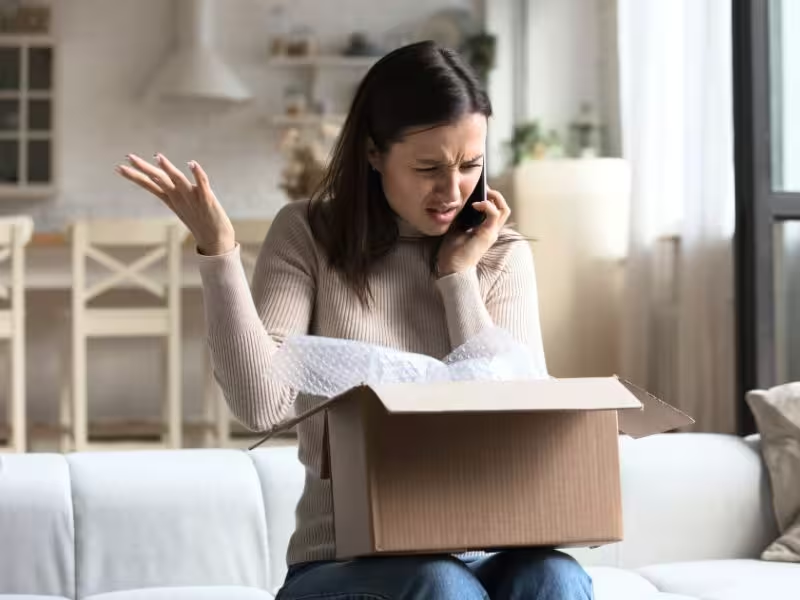
Sign 2: Customer Reviews Say the Product “Isn’t the Same” or “Has Become Lower Quality”
If you start seeing reviews or comments such as “the scent has changed,” “the texture isn’t the same,” “it caused an allergic reaction,” or “the packaging looks strange”—despite having made no changes to your formula or manufacturing process—this is a very clear warning sign. These customers may have unknowingly purchased counterfeit products.
Simple ways to check:
- Assign a team or use social-listening tools to monitor keywords related to your brand across social media and review platforms.
- Ask customers who leave negative reviews to send photos of the product and details of where they bought it, so you can investigate the source.
- Compare customer packaging photos with your brand’s official packaging standards.
Sign 3: Your Products Appear on Unauthorized Channels or at Unusually Low Prices
One of the easiest signs to spot is finding your products being sold by online stores or distributors you have never authorized—especially when prices are noticeably lower than the normal market price. This could be a case of unauthorized discounting by an approved distributor who is violating their agreement, or, more seriously, counterfeit products being sold under your brand name.
Simple ways to check:
- Conduct random monthly checks of major online marketplaces such as Shopee, Lazada, and Facebook Marketplace using your brand name.
- Verify whether the seller is on your list of authorized distributors.
- If you have a distributor-tracking system, trace the product batch to determine which sales territory it was meant for and how it entered an unauthorized channel.

Sign 4: Customers Start Asking, “Which One Is the Genuine Product?”
The product I bought look like the one in the advertisement?” it is a sign that the market is becoming confused between genuine and counterfeit goods. If left unresolved, this uncertainty can spread to potential customers who have never purchased from you before.
Simple ways to check:
- Collect statistics from customer service or chatbot conversations to see whether questions about product authenticity are increasing.
- Monitor customer groups or communities discussing your brand to see whether people are debating which products are genuine or fake.
- If you have a product-authentication system, check whether verification scans are rising unusually in certain locations.

Sign 5: Duplicate Scans or Irregularities Are Detected by Your Product-Authentication System (For brands that already use QR codes)
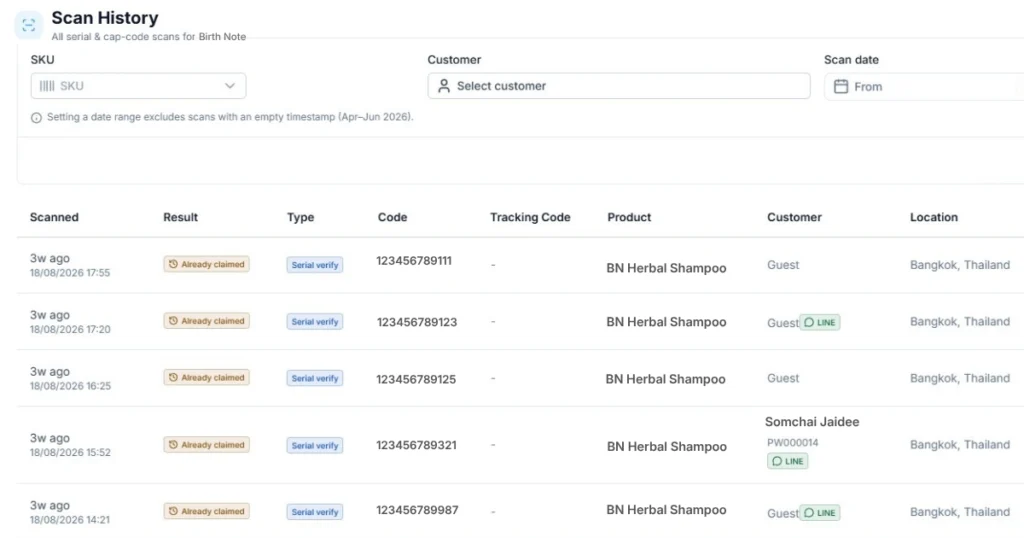
If your brand already uses anti-counterfeit QR codes, this is the most accurate sign to monitor. The system can immediately alert you when the same code is scanned for the second time or more. This may indicate that the QR code has been copied or reprinted.
More importantly, a strong system can identify the location where duplicate scans occur, allowing your brand to trace the source of counterfeiting more precisely. This is far more effective than discovering counterfeits through guesswork or customer complaints alone.
Simple ways to check:
- Review your back-end dashboard regularly to monitor the number of duplicate-scan alerts each week.
- Analyze the locations of duplicate scans to identify whether they are concentrated in particular areas.
- Compare the timing of alerts with changes in sales within those areas.
What Should You Do If You Find These Warning Signs?
Recognizing warning signs is only the beginning. What matters is having a protection system that can be genuinely verified—not simply becoming suspicious and then letting the issue go. The longer the problem is left unresolved, the more widespread the damage to sales and brand credibility will become.
An anti-counterfeit QR code system with a unique encrypted code for every individual item, real-time duplicate-scan alerts, and the ability to identify the location of irregular activity can help brands:
- Detect irregularities early, before customers are the first to complain.
- Trace the source of counterfeiting or unauthorized price-cutting.
- Build customer confidence by allowing customers to verify genuine products themselves using their mobile phones.
- Collect real customer data while preventing counterfeiting, which can also be used to support future marketing efforts.
Summary
Counterfeiting does not usually happen overnight. It often comes with early warning signs that many brands overlook—such as unusual sales declines, reviews saying that products have changed, products appearing on unauthorized channels, customer questions about authenticity, or duplicate-scan alerts from a product-verification system.
The earlier you detect these signs, the better you can control the damage and protect your brand’s reputation.
If you’re seeing these warning signs—or don’t yet have a reliable way to verify genuine products – Birth Note can help
Our team will work with you to design a tailored anti-counterfeit QR code solution that protects your products, strengthens customer trust, and helps you detect risks early. Contact us today for a free brand risk assessment.
Call: 099-564-5947 | 096-142-9547 · We reply within 24 hours
FAQ: Frequently Asked Questions About Anti-Counterfeit QR Codes
Here are some of the most frequently asked questions related to this topic.
📅 Last updated: